Traders of Environmental Progress
STX Group is a global environmental commodities trader offering physical and financial solutions across compliance and voluntary systems for energy, fuels, gas and carbon markets.


Traders of Environmental Progress
STX Group is a global environmental commodities trader offering physical and financial solutions across compliance and voluntary systems for energy, fuels, gas and carbon markets.

Transforming Climate Challenges into Business Progress
STRIVE is the advisory arm of STX Group, helping companies meet climate targets through high-impact strategies and cost-efficient decarbonization pathways.
Blog Articles
The Science Based Targets initiative (SBTi)’s Corporate Net-Zero Standard (CNZS) Version 2.0 represents a significant change in one of the key frameworks driving corporate climate action. This update, which will be effective on February 1, 2027, marks a notable shift by emphasizing actionable plans and tailored approaches based on region and company size. Companies are expected to make best-effort progress toward climate targets, using all available levers within their control to reduce emissions; reporting barriers and progress transparently.
As companies implement the new standard, they will need to prioritize target delivery, tracking progress and more disciplined accountability within 5-year cycles. The shift will be felt at the board level and across operations, procurement, sustainability and finance teams. It will also increase the need to understand how environmental markets, market instruments and high-integrity climate projects can support credible progress.
In term of timing, if your company already holds validated targets, these remain valid until the earliest target year or the mandatory five-year review (unless this indicates that no immediate target update is required). However, you can already benefit from using some of the key features introduced in V2 highlighted below.
Here are five critical insights to help corporates understand the implications and opportunities of the new CNZS.
A major innovation in the revised standard is the categorization of companies: Category A and Category B, with different expectations for climate transition plans, Scope 3 target-setting and assurance requirements.
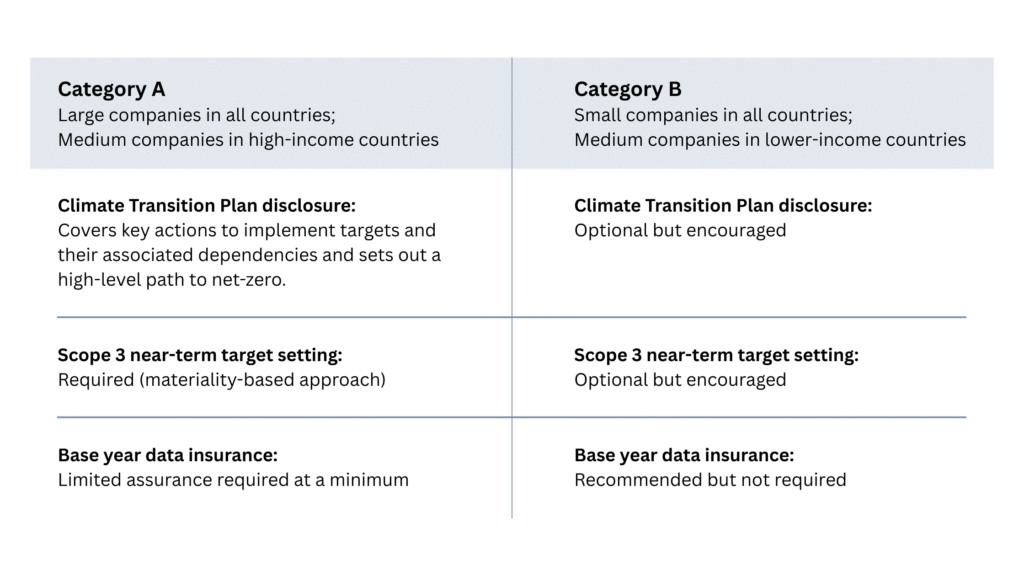
The new standard is not a one-size-fits-all model. Large and medium-sized companies in higher-income countries face stricter requirements, while smaller and medium-sized companies in lower-income countries have more flexibility. This approach recognizes that readiness, resources and data maturity differ significantly across markets.
The standard moves from “renewable” to “low-carbon” electricity (LCE), which includes renewable and nuclear energy, as well as electricity generation fitted with carbon capture and storage, with eligible emissions threshold.
Once a Scope 2 emissions reduction or low carbon electricity alignment target is set, progress must be demonstrated through a broader set of actions, including energy efficiency, on-site generation, PPAs and the procurement of other qualifying market instruments such as unbundled EACs. Direct decarbonization actions should come first, but market-based tools play an important role in showing near-term progress and supporting grid decarbonization.
SBTi also introduces several criteria built around the near, new and now principles. The low-carbon electricity procured should be “near” meaning generated within the same deliverability region as consumption, “new” meaning from assets built within the past 15 years, and “now” meaning generated within the past 12 months. At the end of the target cycle, companies with significant consumption (10 GWh/yr per deliverability region) must also report their hourly matching performance for the target timeframe. There is also an optional program for companies to get recognition for meeting or exceeding set hourly matching thresholds in each reporting years. Legacy clause provisions are included to protect prior long-term contracts, and there are a few limited exemptions to the above-mentioned rules.
The revised framework assigns a clearer role to market instruments in all scopes when direct intervention or full traceability is not feasible, provided these instruments meet integrity standards. Key requirements include verifiability, quantification, unique attribution, prevention of double-counting, temporal alignment and activity matching. Additional guidance is expected from SBTi in the near future.
Instruments such as renewable electricity certificates, certificates for biomethane / RNG and other qualifying market-based actions can support progress toward targets if claims are transparent and accounting is robust.
For companies looking to navigate these complementary instruments, Strive by STX’s role is to provide market access, technical guidance and practical structuring, so climate action remains aligned with business objectives.
Changes to the treatment of Scope 3 emissions in the revised standard are particularly significant for multinational businesses. The new standard introduces a flexible model that prioritizes emissions-intensive activities and categories that each account for more than 5% of Scope 3 emissions. This helps companies focus on where they can have the biggest impact.
Instead of treating all Scope 3 categories the same, businesses can choose from a broader set of approaches: overarching emissions-reduction targets, supplier- or customer-alignment targets and category-specific targets tied to upstream and downstream activities.
Market instruments also now formally have a role in Scope 3 and applications range from procuring EACs within your value chain, to low-carbon cement certificates, to sustainable aviation fuel certificates. The opportunity is greater flexibility. The challenge is greater strategic discipline.
SBTi’s revised approach maintains a focus on direct emissions reductions across operations and value chains. It also recognizes the need for accelerated contributions to achieve global climate objectives, which led to the creation of the Ongoing Emissions Responsibility framework. This framework recognizes companies for their voluntary contributions in the near-term while requiring action from Category A companies post-2035. Climate contributions include supporting verified mitigation outcomes (carbon credits) or establishing and using a contribution budget (internal carbon price).
Carbon and removal credits are not treated as a substitute for in-scope emissions reductions under the CNZS 2.0 revisions. Instead, the standard offers a structured approach for companies to address emissions that have not yet been eliminated. Emissions reductions remain the primary goal, but credible climate finance and removals will play a key role in a strategic climate action roadmap.
The revised standard addresses previous gaps by providing guidance on how to action decarbonization targets. However, achieving net zero remains challenging across different contexts. Companies will need stronger environmental market fluency to overcome barriers to emission reductions.
To prepare for the revised standard, companies should understand how to align actions with the implementation hierarchy, build credible approaches across activity pool activities and sector-level solutions and report progress using qualifying instruments.
With direct access to environmental markets and experience in global compliance and voluntary markets, Strive by STX helps organizations develop decarbonization strategies that balance climate targets with financial performance.
Is your transition plan, implementation strategy and sustainability reporting ready for the next phase of net-zero accountability? Let us help you set targets, build a SBTi-aligned Climate Transition Plan, identify where market instruments can support the delivery of targets and structure strategies that are flexible enough to adapt as new guidance is released.
While the new standard is final, SBTi already announced additional guidance and resources to be published in the coming months, to help corporates navigate these new rules. Stay tuned for more information.
Contact us to book a review of your current decarbonization strategy.