Traders of Environmental Progress
STX Group is a global environmental commodities trader offering physical and financial solutions across compliance and voluntary systems for energy, fuels, gas and carbon markets.


Traders of Environmental Progress
STX Group is a global environmental commodities trader offering physical and financial solutions across compliance and voluntary systems for energy, fuels, gas and carbon markets.

Transforming Climate Challenges into Business Progress
STRIVE is the advisory arm of STX Group, helping companies meet climate targets through high-impact strategies and cost-efficient decarbonization pathways.
Blog Articles
On July 29, 2026, the GHG Protocol released its Scope 2 Public Consultation Summary, providing a detailed summary of feedback received on proposed revisions to Scope 2 accounting. With nearly 1,100 responses from stakeholders across 56 countries, the consultation offers an early indication of where consensus is emerging and where significant debate remains.
A central theme in the feedback is a divide between two competing theories of change for accelerating grid decarbonization. One perspective favors directing corporate capital toward new clean energy generation where and when it is most needed through stringent requirements for temporal matching, deliverability and incrementality (previously referred to as additionality). The other emphasizes maintaining broad corporate participation by allowing a wider range of market-based procurement options with fewer constraints, thereby maximizing investment in clean energy markets overall.
While the final standard remains under development and is not expected to be published in its unified GHG Protocol/ISO format before 2028, the consultation highlights that stakeholders broadly support efforts to improve the accuracy and credibility of Scope 2 reporting. However, significant concerns remain regarding the cost, complexity, feasibility and interoperability of proposed changes with existing reporting frameworks.
One of the most closely watched proposals is the introduction of hourly matching as a market-based quality criterion. Supporters argue that matching electricity consumption and procurement on an hourly basis would better reflect the physical realities of power systems and strengthen the connection between corporate procurement decisions and grid decarbonization outcomes.
Many respondents indicated that hourly accounting could drive demand for a broader portfolio of clean energy resources, including storage, geothermal and other technologies capable of delivering power when it is needed rather than simply generating annual renewable energy volumes. Stakeholders also noted that greater temporal precision could improve transparency and strengthen confidence in corporate renewable electricity claims, limiting perceived risks of greenwashing. The most supportive organization types were data/analytics providers, non-profits and academia, as shown in Figure 1.
At the same time, respondents raised concerns regarding data availability, implementation costs, verification complexity and uneven market readiness across regions. These concerns ultimately led many stakeholders to advocate for phased implementation timelines and targeted exemptions. Others questioned the climate benefits of hourly matching without an accompanying “incrementality” requirement (i.e., limiting claims to newer generation assets). The organizations that were least supportive of hourly matching are industry groups and companies, as illustrated in Figure 1.
Figure 1: Support Gap vs Overall 22% Average1
Difference between the support % from each Organization Type and the overall average of 22%, (# of respondents for each organization type)
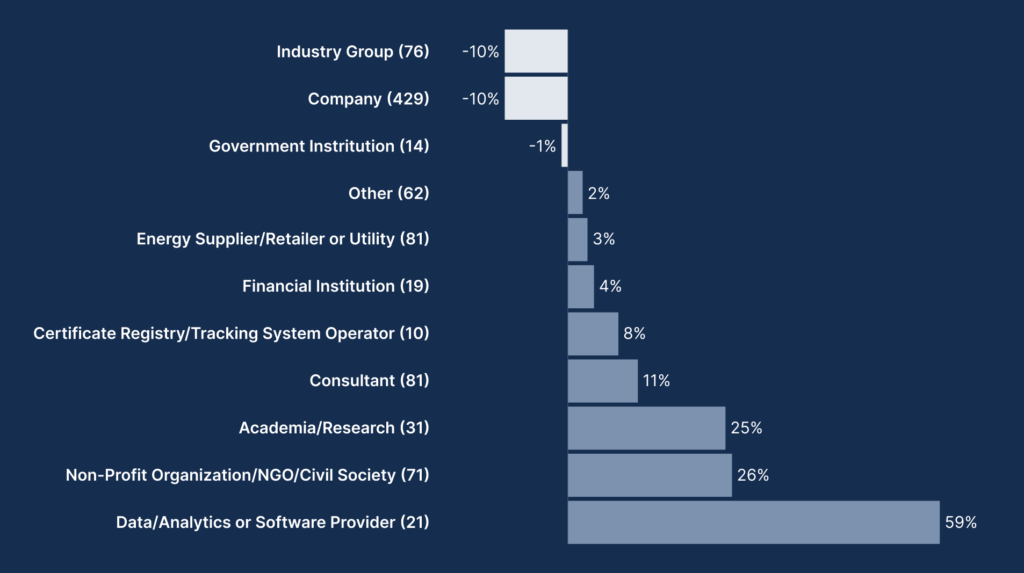
1. Responses to question 71 by organization type. Question 71 asks respondents to provided a 1–5 support rating for updating Quality Criteria 4 to require hourly matching for market-based claims. Excludes Organization Types with less than 10 responses.
Recognizing that hourly accounting infrastructure is not yet available everywhere, the consultation proposed a series of potential exemptions related to hourly matching requirements. Stakeholder feedback suggests broad recognition that flexibility may be needed for smaller organizations, certain geographies and entities facing limited access to high-quality temporal data. The proposed threshold for exemption of 50 GWh annually was the most commonly supported, although respondents debated whether it should apply by country, market boundary or site.
A recurring theme throughout the consultation was the need to balance accounting integrity with practical implementation. Respondents generally supported mechanisms that preserve ambition while acknowledging varying levels of market maturity and data accessibility across jurisdictions. Questions remain, however, regarding how exemptions should be structured and whether they should be temporary transition mechanisms or permanent elements of the standard.
A commonly suggested compromise was to keep hourly matching as a voluntary practice, at least temporarily, eliminating the need for exemptions while preserving participation in the voluntary renewable energy market.
The proposed introduction of a deliverability requirement generated substantial discussion and generated moderately less opposition than hourly matching. Particularly in Europe, views are well balanced, with 46% of respondents showing low or no support but 43% expressing some or strong support. The concept seeks to ensure that renewable electricity claims are linked to electricity generation that can realistically serve the reporting organization’s load, rather than generation located in disconnected markets.
Supporters described deliverability as an important step toward improving the credibility of market-based accounting and strengthening the relationship between procurement decisions and outcomes on the grid. Many respondents noted that deliverability could discourage procurement strategies that rely heavily on low-cost certificates from regions that are not physically connected to consumption. The most supportive organization types were data/analytics providers, government institutions and non-profits, as shown in Figure 2.
Others, however, cautioned that electricity systems are highly interconnected and that defining deliverability consistently across global markets may prove challenging. Stakeholders also highlighted concerns about increased procurement costs, limited product availability in some regions and the potential complexity of verification and assurance. Opponents highlighted that the proposal could restrict impactful procurement, particularly large PPAs, by limiting the aggregation of consumption. More broadly, the proposal sparked debate over attributional accounting versus consequential climate impact (and the treatment of marginal emissions), as it may limit investments in regions where decarbonization benefits could be greatest. The organizations that were least supportive of hourly matching are industry groups and companies, as presented in Figure 2.
Even amongst those who supported the proposal, there was no consensus on proposed boundary definitions.
Figure 2: Support Gap vs Overall 30% Average2
Difference between the support % from each Organization Type and the overall average of 30%, (# of respondents for each organization type)
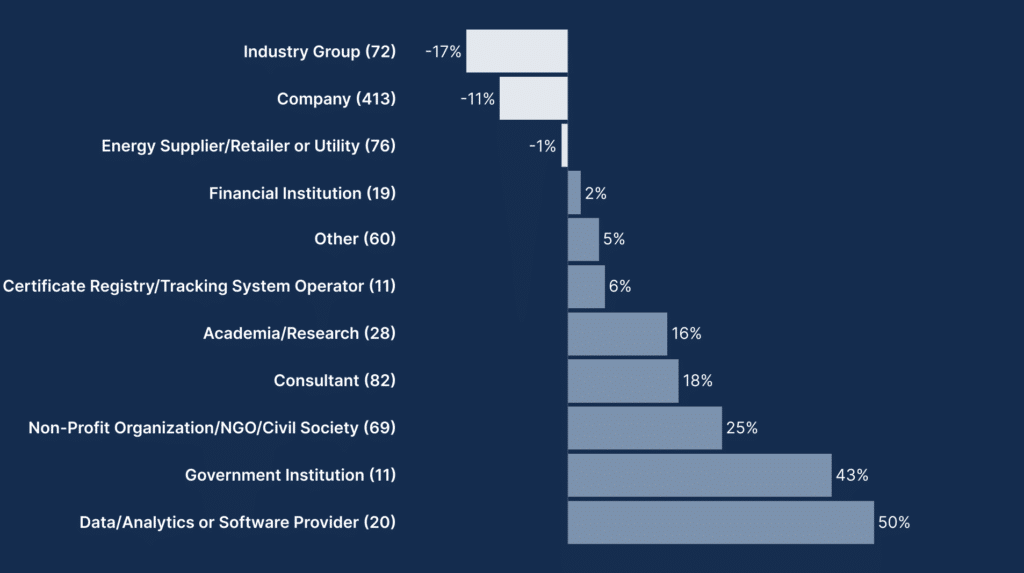
Responses to question 83 by organization type. Question 83 asks respondents to provided a 1–5 support rating for updating Quality Criteria 5 to require deliverability for market-based claims. Excludes Organization Types with less than 10 responses.
The consultation also explored how organizations should account for electricity consumed through standard supply service (SSS) products and how residual mix calculations should evolve. These discussions reflect a broader effort to improve transparency around default electricity products and strengthen accounting treatment for electricity consumption that is not covered by high-quality procurement instruments.
Stakeholders broadly supported efforts to improve consistency, transparency and treatment of utility-provided electricity, while calling for clearer definitions and implementation guidance. Feedback on residual mixes emphasized the need for market-based accounting to better reflect remaining electricity attributes and avoid overstating renewable electricity impacts.
Stakeholders overwhelmingly (90%) supported protecting existing procurement decisions through a legacy clause to honor historical capital allocations. Timely clarity on the parameters of this grandfathering mechanism would avoid pausing or delaying new renewable energy procurement while companies wait for the final standard to be published.
Most respondents favored an eligibility cutoff based on the contract signature date (rather than start of operations, as this can be significantly delayed in the case of greenfield PPAs). Preference for a 10–15 years sunset period was preferred, although some argued that protection should extend for the full natural lifespan of a contract.
Across all market-based proposals, a common challenge emerged: stakeholders largely agree that Scope 2 accounting should encourage more impactful corporate procurement strategies. However, many respondents questioned whether jumping directly into a strict level of mandatory granularity was the best way to drive grid decarbonization and if yes, whether current market infrastructure, data systems and procurement options are sufficiently mature to support immediate implementation at a global scale.
Many participants emphasized that stronger market-based accounting rules could increase decision-usefulness, improve comparability and create more direct links between procurement and grid decarbonization. Others warned that overly prescriptive requirements could increase costs, create inconsistencies with existing regulatory and voluntary reporting frameworks and, more importantly, reduce voluntary market participation.
GHG Protocol has emphasized that the consultation was not intended as a voting exercise. Rather, it served to surface differing perspectives on the most effective pathway to grid decarbonization while also identifying areas where stakeholder views are beginning to converge.
Although the final Scope 2 standard remains under development, the consultation provides an important indication of the direction of travel. Future Scope 2 guidance is likely to place greater emphasis on when clean electricity is generated, where it can be delivered and how procurement decisions contribute to real-world decarbonization outcomes. This could take the form of optional frameworks, differentiated claims or voluntary recognition mechanisms for organizations that go beyond baseline requirements.
For corporates, this suggests that renewable electricity strategies may increasingly need to consider hourly matching, deliverability, residual mix exposure and portfolio design alongside traditional annual REC procurement. Additional requirements related to incrementality may also emerge. Organizations that begin assessing their data readiness, procurement options and long-term energy strategies today will be better positioned to adapt to the next generation of Scope 2 accounting requirements while preserving flexibility as the standard evolves.
Source: GHG Protocol Scope 2 Public Consultation Summary of Feedback (July 29, 2026).