Traders of Environmental Progress
STX Group is a global environmental commodities trader offering physical and financial solutions across compliance and voluntary systems for energy, fuels, gas and carbon markets.


Traders of Environmental Progress
STX Group is a global environmental commodities trader offering physical and financial solutions across compliance and voluntary systems for energy, fuels, gas and carbon markets.

Transforming Climate Challenges into Business Progress
STRIVE is the advisory arm of STX Group, helping companies meet climate targets through high-impact strategies and cost-efficient decarbonization pathways.
Blog Articles
Companies across North America still face pressure to reduce emissions, manage energy costs and demonstrate credible progress toward sustainability targets. Corporate power purchase agreements (PPAs), including virtual PPAs (vPPAs), remain one of the most credible pathways to support new renewable generation while addressing Scope 2 goals. In a volatile market shaped by geopolitical uncertainty, PPAs also offer long-term price stability and a hedge against fluctuating energy costs. However, execution remains challenging. Many companies face challenging PPA economics, uncertainty over evolving voluntary reporting standards, intensifying competition from hyperscalers and limited internal capacity to evaluate and execute deals at the pace the market demands. In this article, we’ll focus on how hyperscalers like Amazon and Microsoft are moving quickly to lock in power supply driven by rapidly growing AI-related energy demand and what this means the majority of the corporate world.
PPAs continue to attract corporate interest because they can address several business problems simultaneously. They can help organizations secure long-term access to renewable electricity and improve the credibility of sustainability claims. PPAs are often viewed as a stronger signal of long-term energy and sustainability strategy because they support the development of new renewable projects.
Second, companies are increasingly prioritizing energy security and risk management amid volatile markets and rising energy demand. Compared with other renewable electricity procurement instruments, PPAs can provide a hedge against future power price volatility, depending on the structure of the PPA and contracting mechanism.
So what factors are leaving even the most seasoned procurement and sustainability professionals stalled on executing PPAs in the US?
The first issue is economics. Input cost pressures, federal policy uncertainty and a more competitive procurement environment have made it harder for some projects to deliver the straightforward economic case buyers may have expected a few years ago. Historically, PPAs were considered a positive business case, netting buyers positive cash flows over the lifetime of the contract. As the market environment has evolved, the economics have flipped. While true performance should be assessed over the lifetime (often 10-15 years) of the contract, buyers increasingly need a clearer strategic rationale when committing to a PPA today, whether that is hedge value, additionality, long-term procurement planning, or all of the above.
The second issue is policy uncertainty. The Greenhouse Gas Protocol (GHG-P), the world’s most widely used greenhouse gas accounting standard for companies and organizations, is currently revising its Scope 2 Guidance for the first time since 2015. The proposed revisions would essentially invalidate a VPPA in a geographic region where the electricity cannot feasibly be delivered to the customers’ load. Similarly, the Science-Based Targets Initiative (SBTi) Corporate Net-Zero Standard Version 2.0 was recently released, and this final version calls for “geographical matching of electricity consumption based on deliverability regions”, but the deliverability regions themselves are up for interpretation. Both include a legacy clause that would permit existing contracts to continue to count for the foreseeable future, but this uncertainty is likely contributing to slower corporate action. Procurement professionals have good reason to feel unsure about what renewable electricity instruments will count and whether they need to start securing renewable energy closer to their organization’s electricity demand (load).
The third issue is competition with hyperscalers. Even when buyers have all the right processes in place, such as issuing an RFP, receiving competitive offers, and advancing to a shortlist, the most attractive projects are often snapped up by tech players before buyers are ready to move forward.
The fourth issue is complexity and internal capacity. PPAs involve many complex factors that companies typically do not manage regularly, including basis risk, congestion exposure, settlement mechanics, credit requirements, and internal governance questions. The above new challenges make it even more complex. Even with strong executive support, the path from consideration to execution can be put on pause if sustainability, finance, procurement and legal teams are not aligned on risk and decision criteria. Many companies may also lack the resources, knowledge and confidence to pursue the right opportunity. Questions such as “Is this too risky?”, “How does a VPPA actually work?” and “Are we too small to compete?” are all common and valid in today’s market, so it can be easy to miss the opportunity.
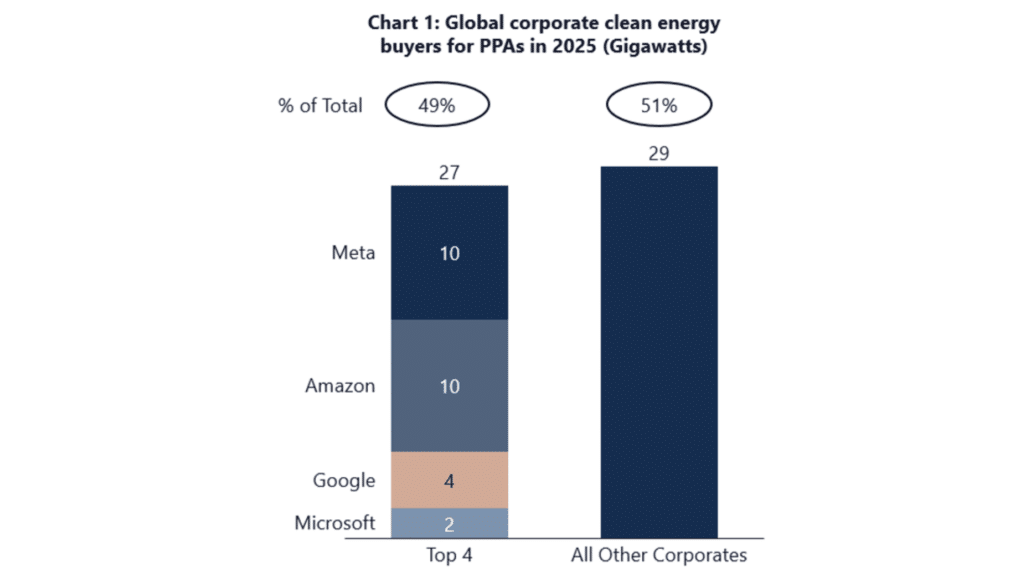
The corporate clean energy market for PPAs has become increasingly concentrated, with just four companies accounting for roughly half of global clean energy purchase deals in 2025, according to BloombergNEF, as shown in Chart 1 below. By comparison, the top four corporates in 2023 only accounted for ~24% of global clean energy purchases.
Source: BloombergNEF
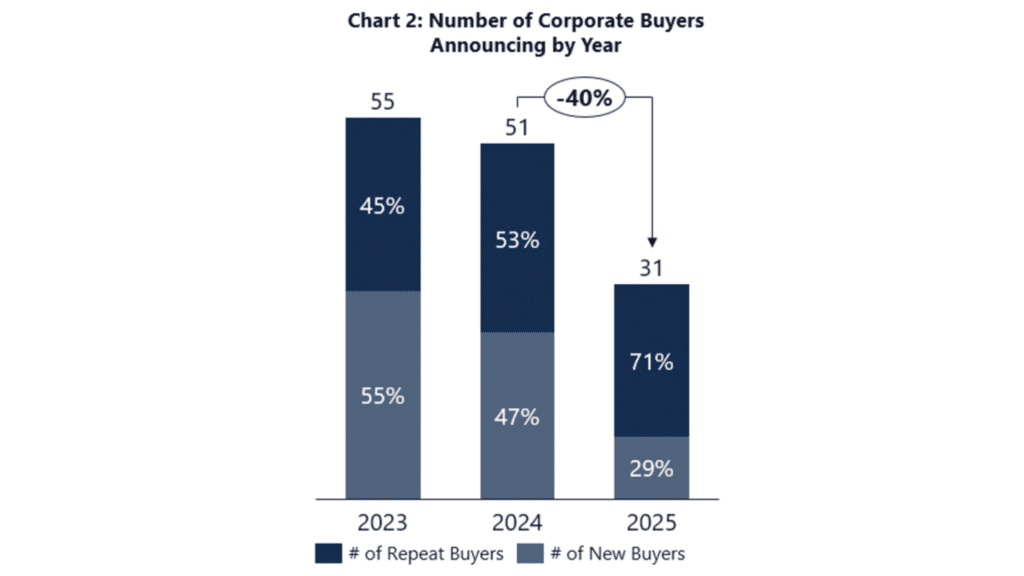
At the same time, the broader buyer pool for PPAs fell 40% percent year over year, creating a two-speed market in which hyperscalers can move quickly while many other corporates may struggle to reach transaction readiness, as observed in Chart 2. For example, based on STX interviews with leading buyers, some hyperscalers can execute a PPA in 2-3 months, while the average timeline for a non-hyperscaler is 6-9 months. Because hyperscalers transact in significantly larger volumes than the average buyer, their continued activity has muted the impact of this shrinking buyer pool on overall market volume, with total demand declining just 10%, far less than the drop in the number of active buyers. Still, this gap was enough to produce the first decline in PPA volumes since 2016, with global clean energy PPA demand in 2025 at 56 GW, down from 62 GW in 2024.
Source: CEBA
This decline in both volumes and new buyers could signal market saturation. Most corporates with the risk appetite for a PPA have already secured the right contracts for their renewable energy needs. For example, consider a consumer goods company whose electricity demand is not growing materially year over year. If the company signed a VPPA in 2022 to meet their entire load, they may now be covered for at least the next 5-10 years.
Still, there are over 700 organizations in North America alone with near-term Scope 1 and 2 targets or commitments, based on the Science Based Targets initiative (SBTi). If only 10% of that pool becomes active, after accounting for companies that have already signed PPAs or lack the demand, that implies around 70 incremental buyers, more than double the 31 unique global buyers reported in 2025.
More corporations want to take action, but the market can feel inaccessible. Larger companies are often the most active buyers, with larger teams, greater risk tolerance, more flexible balance sheets, and the capacity to evaluate and negotiate multiple deals more quickly and at once. That combination can make the market feel out of reach for companies that still have meaningful electricity demand and sustainability goals to meet. Yet, savvy buyers still recognize that the benefits of PPAs and related opportunities become increasingly viable when they understand the current landscape.
Hyperscalers have unquestionably raised the bar in renewable procurement, but their presence does not mean the market is closed to everyone else. In practice, non-hyperscalers do not need to outspend large technology companies to use PPAs effectively. They need to right-size the strategy, the deal structure and the developer universe to fit their own load, risk tolerance and decision-making process.
One overlooked opportunity is that many smaller and mid-sized developers may be better aligned with a corporate buyer looking for practical volumes, realistic timelines and a more tailored procurement approach. In the U.S. alone, there are hundreds of developers with less than 500MW of total capacity across their portfolios that could align well with small to mid-sized corporate demand. Rather than competing head-to-head for the largest and most visible projects, companies can often achieve better outcomes by focusing on the right project, in the right market, with the right structure.
This complex work requires sought-after expertise to navigate the PPA market, assess risks, and compare structures, to ultimately determine whether a right-sized deal is available without competing directly with the largest market participants. Strategic advisors like STX have access to these small-and-medium-sized developers through our existing relationships and can help find the right opportunity for each corporate.
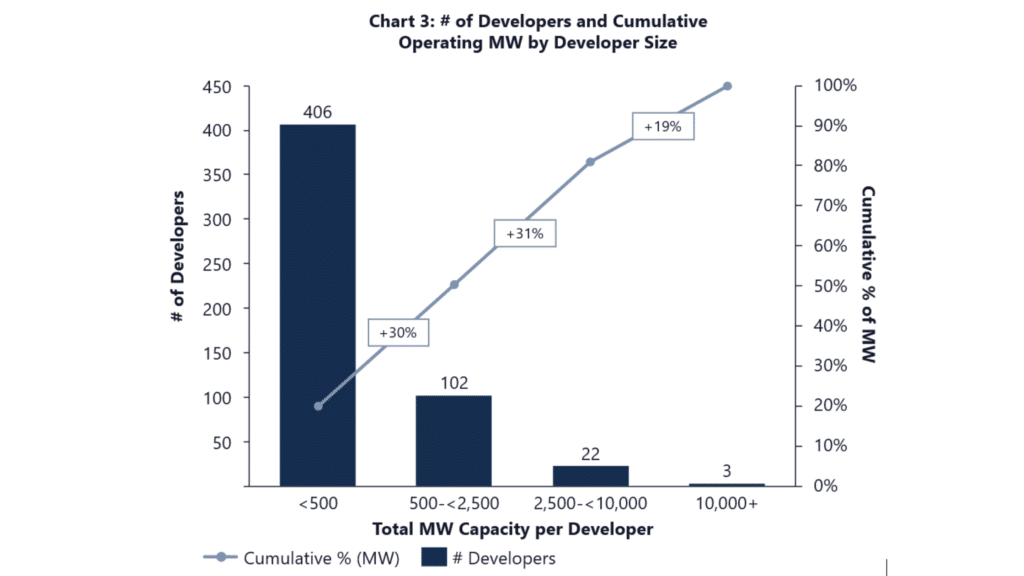
Source: STX, Excludes unknown developers and developers with <50 MW portfolio, selects one developer per project for those with multiple developers, data represents 2010-2026
It’s not just a question of “Should we do a PPA?” Companies must ask themselves, “Given our organization and increased competition, can we move fast enough to execute a PPA?”
For companies without hyperscaler-scale teams or budgets, a strategic energy procurement partner can help increase the pace of execution and unlock real value in the right opportunities. To do so, strategic partners like STX help condense the timeline by aligning internal stakeholders on common terms, implementing a decision-making governance structure, establishing standard terms and contracts and leveraging AI to increase efficiency when evaluating contracts against a company’s preferred terms.
The aim is to shift the discussion away from hype or hesitancy toward readiness, governance and commercial fit. It also opens the door to a more practical evaluation of whether a VPPA, a physical PPA, a REC strategy or a blended approach makes the most sense for your company.
Stay tuned for a developer spotlight and a deep dive into PPA alternatives such as asset-specific RECs.